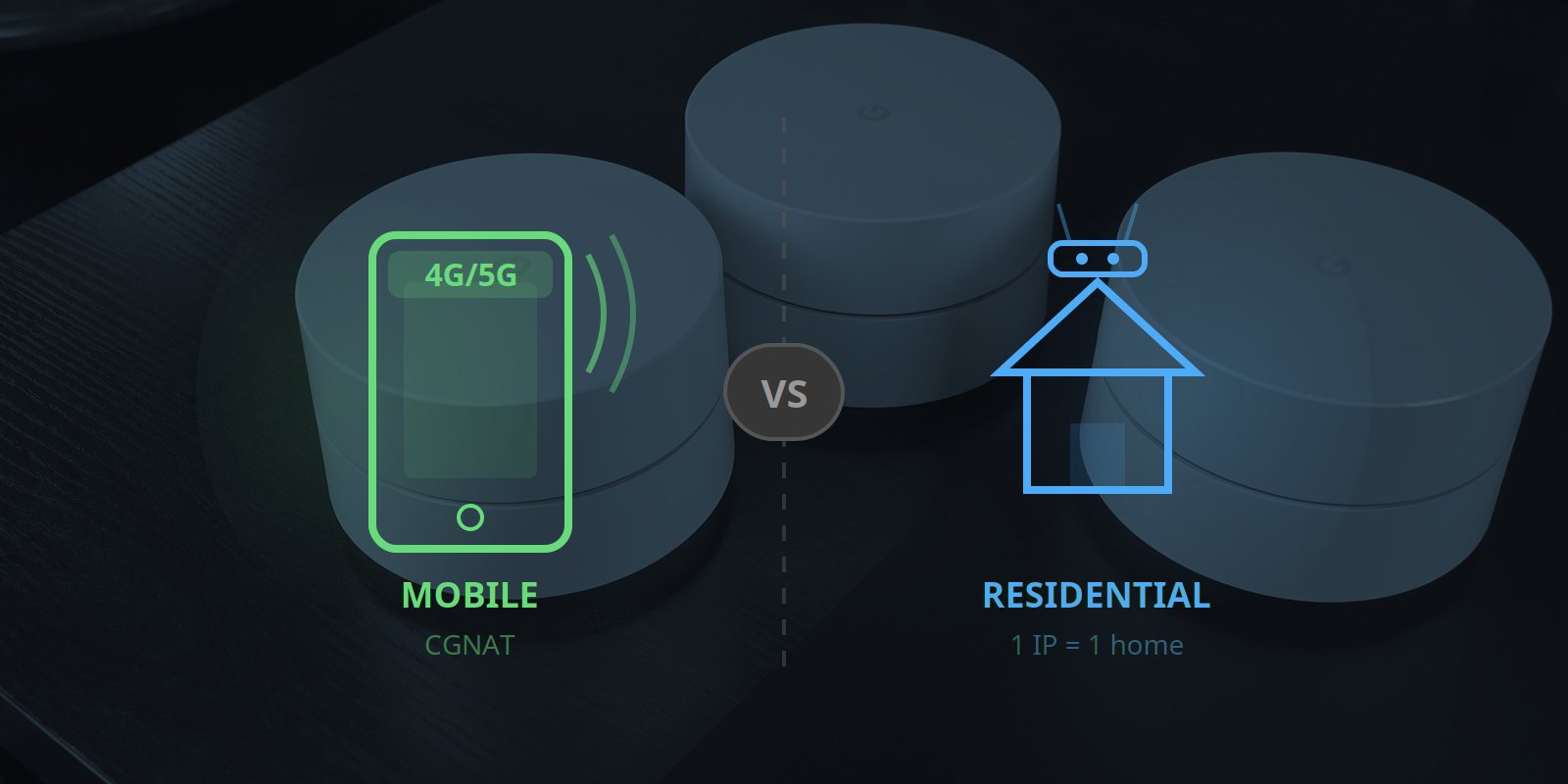
Both mobile and residential proxies use real IP addresses assigned to real people and devices — which puts them in a different class from datacentre proxies entirely. But the similarity ends there.
Mobile and residential IPs come from different infrastructure, behave differently on the network, carry different trust scores, and serve different use cases. Choosing the wrong type is a common and expensive mistake.
This guide breaks down the technical and practical differences so you can make the right call.
The Core Difference: Where the IP Comes From
Residential Proxies
A residential IP is assigned to a home broadband connection — a router sitting in someone's house, connected to an ISP like BT, Sky, Virgin Media, or TalkTalk. These IPs are registered to an ISP that provides home internet service.
In practice, most residential proxy services don't actually own those home connections. They aggregate IPs through one of two methods:
- Peer-to-peer networks: Users install an app or SDK that lets the proxy provider route traffic through their home connection in exchange for some benefit (cash, premium app access, etc.)
- Botnet-style collection: Less ethical providers scrape IPs from infected devices
The IP appears to belong to a UK residential address, which is enough to pass basic geo-checks.
Mobile Proxies
A mobile IP is assigned by a mobile network operator or MVNO to a device on their network. Unlike residential broadband, mobile networks use Carrier-Grade NAT (CGNAT): a single IP address is shared by hundreds or thousands of devices simultaneously.
Mobile proxy services either operate real physical devices (dedicated hardware) or aggregate IPs from smartphones running an SDK — the same peer-to-peer model as residential, but sourced from mobile connections rather than home broadband.
Key Technical Differences
IP Assignment and Rotation
| Property | Residential | Mobile |
|---|---|---|
| IP per device | Usually 1 dedicated IP | 1 IP shared across hundreds of devices |
| IP rotation | Manual or timed rotation | Natural rotation every time device reconnects |
| Sticky sessions | Often available (10–30 min) | Available on most providers |
| IP diversity | One IP per household | Massive — thousands share a single IP |
The CGNAT structure of mobile networks is one of the most important technical differences. When a website sees a mobile IP, it knows that blocking that IP will affect hundreds of legitimate users — so it's far less likely to do so. This structural advantage doesn't exist for residential IPs, where one IP = one household = safer to block if suspicious.
ASN Classification
Every IP address belongs to an Autonomous System (AS) — a network operated by a specific organisation. When a website checks an IP's ASN, it can immediately tell whether that IP belongs to:
- A cloud provider (AWS, DigitalOcean, Cloudflare) — highest block rate
- A residential ISP (BT, Sky, Virgin Media) — medium block rate
- A mobile carrier — lowest block rate
Anti-bot systems weight these differently. Mobile carrier ASNs carry the highest trust because:
- They're associated with genuine human smartphone usage
- Blocking them means blocking huge numbers of real users
- Mobile users generate high-value, legitimate traffic that platforms want
IP Geolocation Accuracy
Residential IPs geo-locate to a specific house or neighbourhood with reasonable accuracy. Mobile IPs geo-locate to a carrier's network region — which might cover an entire city or county. For most use cases this doesn't matter, but it's relevant if you need hyper-local UK geo-targeting (specific postcode, specific borough).
If you need IP-level precision down to a specific London postcode, residential may actually serve you better. For national-level UK targeting, mobile is superior.
Trust Score Comparison
Anti-bot systems like Cloudflare, DataDome, PerimeterX, and Akamai Bot Manager score IPs on a range of signals. Here's how mobile and residential IPs compare on the factors that matter:
| Signal | Residential | Mobile |
|---|---|---|
| ASN reputation | Good | Excellent |
| IP sharing (CGNAT) | No | Yes (massive advantage) |
| IP age and history | Variable | Generally good |
| Blacklist frequency | Moderate | Low |
| Device fingerprint consistency | Variable | Consistent (real hardware) |
| Blocking collateral risk | Low (1 user) | Very high (thousands of users) |
Overall: Mobile IPs carry a structurally higher trust score. This isn't a vendor claim — it's a consequence of how mobile networks work and the incentives anti-bot providers face when deciding whether to block an IP.
Practical Performance Comparison
For Web Scraping
Residential: Works well for general-purpose scraping. Wide IP pool means high diversity. Good for targets with moderate anti-bot protection.
Mobile: Better for high-value targets with aggressive anti-bot protection (e-commerce checkouts, flight booking engines, social platforms). The CGNAT advantage makes mobile IPs significantly harder to block at the IP level.
Verdict: For most UK scraping tasks, mobile is the better choice for reliability. Residential may suffice for simpler targets.
For Social Media Management
Residential: Home broadband IPs are recognisable as legitimate but don't match the fingerprint of a smartphone user. Running an Instagram account from a residential IP works but can be flagged if paired with other signals.
Mobile: Matches the expected connection type for social media use. Instagram, TikTok, and X are used overwhelmingly on mobile devices. A UK mobile IP from a real carrier is exactly what these platforms expect to see from a legitimate UK account.
Verdict: Mobile is clearly better for social media account management.
For Ad Verification
Residential: Can work for verifying some UK ad placements. However, many sophisticated cloaking systems specifically distinguish between mobile and desktop connections.
Mobile: The only legitimate way to verify UK mobile ad placements. Ad servers that serve different content to mobile vs desktop will show you the correct mobile version only when you come from a genuine mobile IP.
Verdict: Mobile is required for mobile ad verification. Residential is not a substitute.
For SEO Monitoring
Residential: Works adequately for desktop SERP monitoring. Will not return mobile SERP results accurately because the IP classifies as desktop broadband.
Mobile: Returns accurate mobile SERP data. Google's mobile-first indexing means mobile SERPs increasingly differ from desktop results — rankings, featured snippets, local pack results, and ad placements can all vary.
Verdict: Mobile for mobile SERPs (increasingly the primary index). Residential works for desktop SERP checks.
Price Comparison
Genuine mobile proxies are a premium product — real SIM cards, real devices, and real carrier connections cost more to operate than datacentre or residential infrastructure. Here's how mobile proxy pricing compares across the market:
| Provider | Mobile (per GB) |
|---|---|
| Oxylabs | ~$3.50–7.50 |
| Bright Data | ~$4.00–8.40 |
| IPRoyal | ~$5.20–6.80 |
| Proxy-Cheap | ~$5.99 |
| Decodo (Smartproxy) | ~$2.25–4.00 |
| Simply Proxies | $2.55 (£2.00) |
Which Should You Choose?
Use this decision guide:
Choose UK mobile proxies if:
- Your target site has aggressive anti-bot protection
- You need to verify mobile ad placements
- You're managing social media accounts that need to appear as UK smartphone users
- You need accurate UK mobile SERP data
- You're scraping UK-specific targets (e-commerce, travel, job boards) at scale
- You want the lowest possible block rate
Choose UK residential proxies if:
- You need hyper-local UK IP geolocation (specific postcode)
- You need a very large IP pool with high diversity
- Your target has moderate (not aggressive) anti-bot protection
- Cost is the primary constraint and mobile pricing is prohibitive
- Desktop SERP monitoring is the primary use case
Choose datacentre proxies if:
- Speed is the absolute priority
- The target has no meaningful anti-bot protection
- Volume is high and IP quality is less important
The Bottom Line
Mobile and residential proxies both use real IP addresses, but mobile IPs carry a structural advantage from CGNAT that makes them harder to block without collateral damage to the carrier's legitimate user base. For UK-specific tasks — especially mobile ad verification, social media management, and high-value scraping — UK mobile proxies are the right tool.
The main trade-offs for mobile are: higher cost per GB, smaller IP pool, and slightly less precise geolocation. For most use cases requiring UK mobile authenticity, these are acceptable.
Try UK Mobile Proxies Free
Get 500 MB free on Simply Proxies. Real devices, genuine UK mobile connections, HTTP + SOCKS5.
Start Free Trial